
Binnenstebuiten
Binnenstebuiten
A group show with installations by Enrique Gutiérrez, Yamadatesla and Marnix Postma
Museumnacht Amsterdam, Saturday 7 November, 19:00–02:00
“Binnenstebuiten” begins at a fold between the Self and the world. Introspection is not a retreat but a way of reading, where turning inward is how the outside becomes manifest. The Self is where the world takes shape.
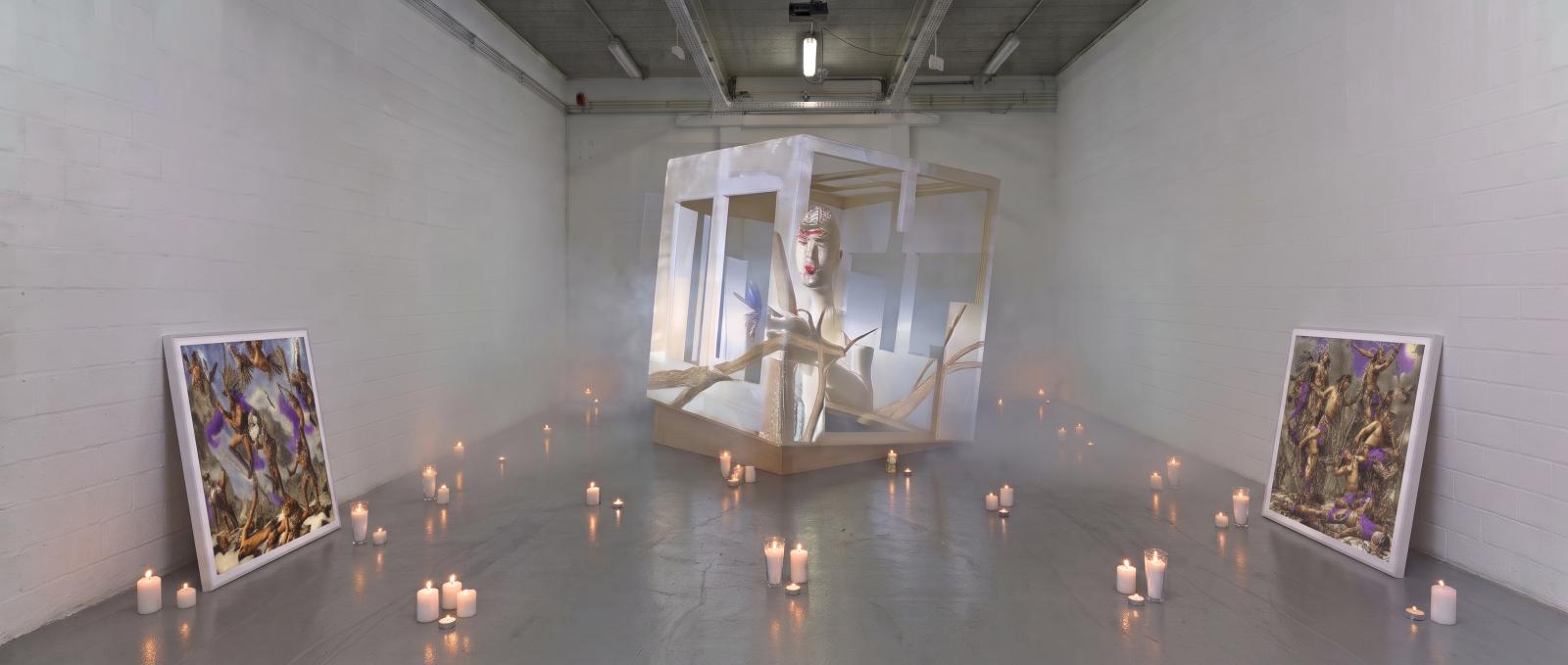
Enrique Gutiérrez works with machines that make images, sound and objects, treating the model as an archive that talks back: partial, borrowed and never quite finished. Yamadatesla merges 3D digital forms with handmade sculpture, using introspection to open subtle, enigmatic worlds where identity, gender and lived experience become shared questions. Marnix Postma presents Remnant, a white cube built on the golden section and the Fibonacci sequence, its presentation marks a way of working he has consciously let go of.
Artist Statement — Marnix Postma
My practice begins with getting out of my own way. Rather than creating from a plan, I make space for pure creativity to flow through me, so that ideas can arrive from somewhere deeper: my Soul and Higher, or Deeper, Self. I see each work as a manifestation, an idea taking form in the material world in accordance with the Evolution Stream.
What comes through takes different forms. In my visual work it appears as abstraction, in paintings and spatial installations. It also takes shape as conversation, in my podcast; as play, in GridLuck; and as community, in DE BOUWPUT. Each is a different vessel for the same source.
Whatever form it takes, the work isn’t meant to be decoded, but experienced. My hope is that experiencers remember the same space within themselves, a place of stillness and openness, and that they begin or continue to give form to their own lives from there.
Artist Statement — Yamadatesla
As a multimedia artist, I explore identity and lived experience through a visual language that merges 3D digital forms with handmade sculptural elements. Blending post-conceptual lyricism with organic ornamentality, I open subtle, enigmatic worlds that move beyond conventional perception and the limits of language.
I approach my work as a form of introspection that invites reflection in others. Themes such as awareness, the essence of events, and the universal dimension of human existence form its conceptual ground and connect it to contemporary social conditions.
Feminism and gender remain central to my research, not as fixed narratives but as complex cultural frameworks that invite inquiry. Through them, I seek shared emotional resonances, creating work that speaks to a wide audience, raises urgent societal questions and challenges established norms.
Artist statement - Enrique Gutiérrez
I am a Mexican artist based in Amsterdam, trained as an interaction designer and audio engineer. I work with AI models, sound, projection and software I write myself. Since 2020 my work has asked what colonialism left of Mesoamerican cultures, and what machines hallucinate from what remains.
The work began during a residency supported by the Mondriaan Fund and STEIM, where I trained a GAN on codices, catalogues and museum photographs of Mexica objects. It generated stones no one had carved. Later, a diffusion model trained on similar sources produced images in which bodies merge with feathers and gold, and imagery from elsewhere in Indigenous America drifts in.
These errors belong to the material. The past these machines learn from was recorded under duress: colonial codices drawn under the direction of friars, tales written down for those same friars, objects taken by empires and kept behind glass in European museums. What was not erased was overwritten. A model trained on this record inherits its ghosts, and when it hallucinates, they surface, half-remembered and tangled with what came after.
Not all the ghosts are old. Some of what surfaces, such as the generic feathered headdress, comes from the internet images the model was first trained on, where "the Indian" is still a single, flattened figure. The colonial record did not close in the sixteenth century; the machine is still writing it. I select these images, project them onto stone, print them and pair them with sound, so that the room holds both: what was lost, and how it keeps being overwritten.